

Congratulations to the Winners of the 2025 ACS Infectious Diseases Young Investigator Award
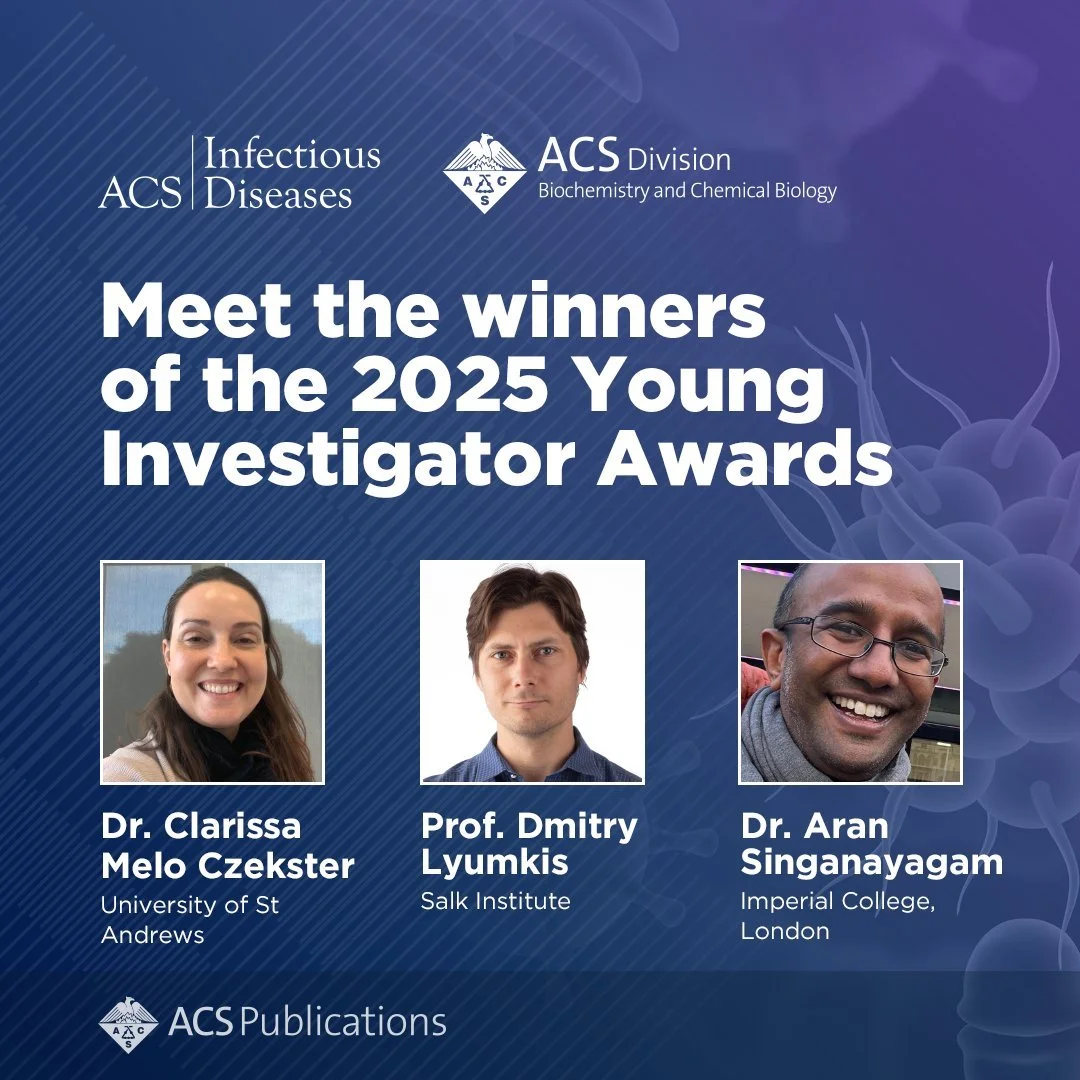
The Editors of ACS Infectious Diseases and the ACS Division of Biochemistry and Chemical Biology (BIOL) are pleased to announce the winners of the 2025 ACS Infectious Diseases Young Investigator Joint Lectureship Awards:
Clarissa Melo Czekster, University of St. Andrews
Dmitry Lyumkis, Salk Institute
Aran Singanayagam, Imperial College, London
The ACS Infectious Diseases Young Investigator Award recognizes three outstanding early-career investigators conducting infectious diseases research. The award honors the recipients’ contributions to the field of infectious diseases research at an early stage in their careers.
The awards will be presented at ACS Fall 2025 in Washington, DC, on Monday, August 18 from 2-6 PM.
Clarissa Melo Czekster is a Reader in the School of Biology at the University of St Andrews. Her lab combines enzymology, structural biology, chemical biology and microbiology to understand how bacteria produce and use cyclic peptides in interspecies and interkingdom warfare and/or cooperation. Their purpose is to generate novel drugs, probes, carriers, and technologies that will allow us to control and modulate bacterial populations.
Dmitry Lyumkis is an Associate Professor at the Salk Institute for Biological Studies. His lab utilizes and develops cutting-edge transmission cryo-electron microscopy techniques to determine the structures of macromolecules and macromolecular assemblies. By observing previously unseen structures under different physiological conditions and at near-atomic resolution, he aims to understand and interconnect the complex roles macromolecules play in human diseases such as cancer and HIV.
Aran Singanayagam is an MRC Clinician Scientist, Group Leader at the Centre for Bacterial Resistance Biology (CBRB) at Imperial College and a Consultant in Respiratory Medicine at the Royal Brompton and Harefield NHS trust. His lab uses cutting edge immunological and molecular microbiological techniques to elucidate the functional roles of commensal bacteria, viruses and fungi residing in the respiratory tract.
For more information about this year’s winners, check out the official award announcement on ACS Axial.