

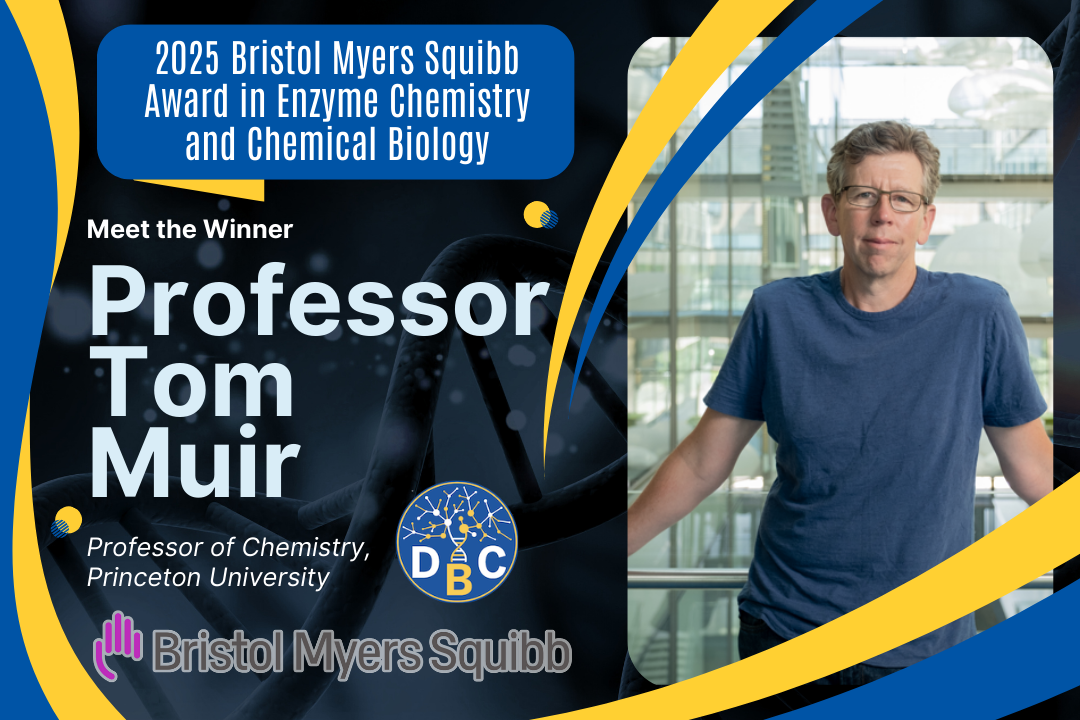
The Division is very excited to announce that Professor Tom Muir is the recipient of the 2025 Bristol Myers Squibb Award in Enzyme Chemistry and Chemical Biology. Administered by the Division of Biochemistry and Chemical Biology (BIOL) of the American Chemical Society (ACS) and sponsored by Bristol Myers Squibb, this award aims to recognize a prominent scientist whose research accomplishments in biochemistry or chemical biology are unusually significant and far-reaching. Professor Muir is a world leader in chemical biology, a member of the National Academy of Sciences, a Fellow of the Royal Society, and one of the most visible members of the field of chemical biology today.
After completing his Ph.D. in Organic Chemistry at the University of Edinburgh, UK, and postdoctoral work at the Scripps Research Institute, Muir joined The Rockefeller University as an assistant professor in 1996. After serving as the Richard E. Salomon Family Professor and Director of the Pels Center for Chemistry, Biochemistry and Structural Biology for 5 years, Muir became the Van Zandt Williams, Jr. Class of ’65 Professor of Chemistry at Princeton Univerisity in 2010.
Professor Muir has made contributions to the fields of peptide and protein chemistry. He is well known for developing general methods for the preparation of proteins containing unnatural amino acids, post-translational modifications (PTMs) and isotopic probes. These chemical tools, now widely employed in academia and industry, have yielded detailed functional insights in many systems including protein kinases, ion channels, and chromatin.
His work on chromatin, which remains a major focus of his group, has yielded fundamental insights into many epigenetic processes, including how enzymes that act on chromatin are regulated by post-translational modifications on histones and how cancer-associated histone mutations corrupt transcriptional programs and transform cells. He is also well known for his work in the bacterial quorum sensing where over the course of more than two decades he has dissected the signaling pathways that control virulence in Staphylococci. This work has yielded detailed molecular mechanisms governing the biosynthesis of the active thiolactone-containing signaling peptides and how they regulate the virulence response through a two-component signaling cascade. Notably, this work yielded the first global inhibitors of a bacterial quorum sensing pathway and demonstrated that these molecules can prevent S. aureus infections in animals. The quorum sensing work also provided valuable reagents to the research community including the first antibodies against phosphohistidine.
The Division of Biochemistry and Chemical Biology will be hosting a symposium in Professor Muir's honor at the Spring 2026 ACS National Meeting of the ACS in Atlanta, Georgia. Stay tuned for more details!